[90] Topicalization can also be accomplished making use of a mix of phrase order and intonation; for instance all of the next sentences give a different place of emphasis:
Balkan languages are actually exchanging for a long time their lexical items. These languages share sets of typological properties as well as their grammatical framework, other than the variances, demonstrate Various other similarities. Matter of this paper is the topic from the Balkan languages, its construction and its place, the phenomenon of the Null Issue. We're going to present the similarities and the dissimilarities involving issue construction within the Balkan languages. The composition of the topic is really a syntax concern, it issues Along with the linguistic factors which play this purpose In the clause. This paper analyzes the Noun Phrases while in the role of the subject, also their constituents, like determinatives, modifiers and quantifiers. We learned that there are construction similarities in Balkan topics like: the determinatives place, their purpose Within the NP structure, the Portion of speech that could have the subject’s functionality. A vital difficulty is the subject’s place within the clause, its relations With all the predicate and the phrase order of some Balkan languages.
[119] The identical 12 months Bulgaria revoked its recognition of Macedonian nationhood and language and implicitly resumed its prewar posture in their non-existence.[120] In 1999 the government in Sofia signed a Joint Declaration inside the official languages of the two international locations, marking The 1st time it agreed to indication a bilateral settlement written in Macedonian.[121] Dialect professionals on the Bulgarian language check with the Macedonian language as македонска езикова норма (Macedonian linguistic norm) of the Bulgarian language.[ten] As of 2019, disputes concerning the language and its origins are ongoing in tutorial and political circles in The 2 international locations.
Krste Petkov Misirkov (pictured) was one of several to start with to stipulate the distinctiveness with the Macedonian language in his guide Za makedonckite raboti (To the Macedonian Issues), posted in 1903. The latter 50 % of the 18th century saw the rise of modern literary Macedonian with the composed utilization of Macedonian dialects generally known as "Bulgarian" by writers.
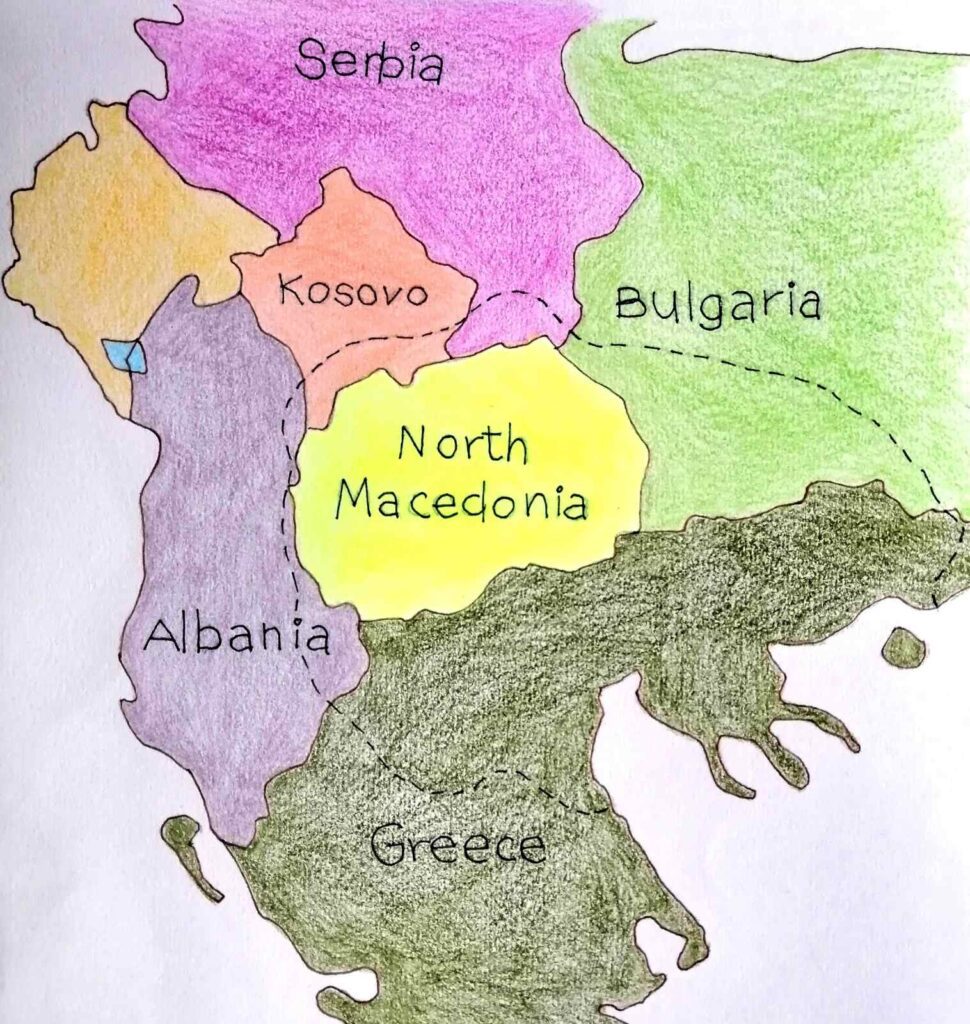
Macedonian, like the opposite Japanese South Slavic idioms has characteristics that make it Component of the Balkan sprachbund, a gaggle of languages that share typological, grammatical and lexical capabilities based on areal convergence, as an alternative to genetic proximity.
Even though it is predicated at Ca’ Foscari College of Venice, the Journal aims at offering a world tutorial System where scholars and researchers Operating inside of both of those the traditional and the more just lately made experimental frameworks can share novel ideas and advance theoretical proposals in the field of Slavic and Balkan linguistics.
Grammar with the language of the Slavic Macedonian population written by Georgi Pulevski in 1880 marks the very first attempt at standardisation for the Macedonian language in the Galičnik dialect. The interval concerning 1840 and 1870, saw a wrestle to define the dialectal foundation of your popular language termed only "Bulgarian", with two opposing sights emerging.
The comparison of the kinship conditions displays that these methods have been afflicted by a distinct degree of convergent balkanization processes. Consequently, 4 Balkan kinship techniques share similar qualities as opposed to Greek This summary is essential for cross-linguistic typological research since the contrastive description from the kinship phrases advances the examine of your lexical-semantic typology of Balkan languages.
As Bulgarian, Macedonian and Albanian have grammatical evidential techniques at the same time, There exists an issue how the lexical evidential markers communicate with evidential kinds. Listed here the distinction among analytic and holistic looking through is often quite helpful, mainly because it clarifies the job of each and every of your factors in constructions. Inside the write-up it really is analysed on the basis of tra...
This article analyses, within the framework of cognitive linguistics, the use of some H2o metaphors in the phraseology of a few Balkan languages, Albanian, Macedonian and Modern day Greek. Drinking water, which occupies a substantial spot in human expertise and perception, supplies a versatile framework for metaphorical expression in various components of human lifetime. In phraseology, these metaphors are more likely to Perform a crucial purpose in conveying summary concepts and cultural Tips rooted inside the experience of h2o and its several manifestations inside the a few Balkan languages.
In keeping with Chambers and Trudgill, the issue whether or not Bulgarian and Macedonian are distinctive languages or dialects of only one language cannot be solved with a purely linguistic basis, but should really relatively take into consideration sociolinguistic criteria, i.
Expressions compiled from the Slovenian! Linguistic! Atlas, significantly vary on quite a few concentrations: phonologically, morphologically, motivationally in addition to inside the word development system. The most fascinating expressions in the semantic and motivational point of view are those fashioned because of the semantic transform.
However, ethnography, to be a methodological sociolinguistic Resource, can not substitute or supersede cognitive aspects of language. If performing LL exploration signifies accomplishing semiotic landscape investigate, then we even have to take into consideration semiosis and higher-get indexicality qua categorization. I comprehend ethnographic LL analysis as contributing to a better comprehension with the dynamic indexical relation among language and Actual physical space (changed into spot through human agency). Just as a certain accent and certain morphosyntactic selections may perhaps index the position of origin of a speaker, a selected LL may well index populations as well as their socioeconomic relations at a specific historic instant. Concentrating on these dynamic indexical relations might have considerably-reaching effects for superdiversity as a way of constructing perception of language-in-society.
An ideal tense may be fashioned making use of the two to become (сум) and to obtain (има) as auxiliary verbs. The initial form inflects the verb for particular person and uses a previous Lively participle: сум видел многу работи ("I have viewed lots of points"). The latter kind Sprachentwicklung im Balkanraum tends to make usage of a clitic that agrees in number and gender with the thing from the sentence plus the passive participle in the verb in its uninflected form (го имам гледано филмот, "I've observed that Motion picture").
There is absolutely no big difference in which means, Even though the latter form is a lot more frequently used in spoken language. Yet another future tense is upcoming in past times which can be formed utilizing the clitic ќе plus the previous tense from the verb inflected for human being, таа ќе заминеше ("she might have left").[eighty]
A attribute element of your nominal procedure is the indication of definiteness. Just like other Slavic languages, there is absolutely no indefinite short article in Macedonian. The definite posting in Macedonian is postpositive, i.
Welche Sprache spricht man in Mazedonien?
Viele Menschen stellen sich die Frage: Welche Sprache spricht man in Mazedonien? Die offizielle und am weitesten verbreitete Sprache ist Mazedonisch. Sie wird von der Mehrheit der Bevölkerung als Muttersprache gesprochen und dient als Amtssprache in Verwaltung, Politik, Bildung und Medien. Im alltäglichen Leben ist Mazedonisch allgegenwärtig und verbindet Menschen unterschiedlicher Generationen.
Neben der mazedonischen Sprache existieren jedoch weitere Sprachen, die von ethnischen Minderheiten gesprochen werden. Besonders Albanisch nimmt eine bedeutende Stellung ein und wird in bestimmten Regionen auch offiziell verwendet. Diese sprachliche Vielfalt ist ein charakteristisches Merkmal Mazedoniens und zeigt die multikulturelle Struktur des Landes.
Mazedonische Sprache: Herkunft und Besonderheiten
Die Mazedonische Sprache gehört zur südslawischen Sprachfamilie und ist eng mit dem Bulgarischen und Serbischen verwandt. Trotz dieser Nähe besitzt sie eine eigenständige grammatikalische Struktur und einen eigenen Wortschatz. Geschrieben wird Mazedonisch mit dem kyrillischen Alphabet, das speziell an die Lautstruktur der Sprache angepasst wurde.
Ein besonderes Merkmal der mazedonischen Sprache ist ihre vergleichsweise einfache Grammatik im Vergleich zu anderen slawischen Sprachen. Bestimmte Artikel werden direkt an das Substantiv angehängt, was sie von vielen europäischen Sprachen unterscheidet. Diese sprachlichen Eigenschaften machen Mazedonisch sowohl einzigartig als auch interessant für Sprachwissenschaftler.
Sprache in Mazedonien: Alltag und Mehrsprachigkeit
Die Sprache in Mazedonien ist stark von Mehrsprachigkeit geprägt. Aufgrund der ethnischen Vielfalt des Landes werden im Alltag häufig mehrere Sprachen parallel verwendet. In vielen Städten ist es üblich, dass Menschen Mazedonisch und Albanisch oder andere Sprachen fließend sprechen.
Die mazedonische Verfassung erkennt die sprachlichen Rechte von Minderheiten an, was zu einem offenen und inklusiven Sprachsystem geführt hat. In Schulen, öffentlichen Institutionen und sogar im politischen Diskurs ist Mehrsprachigkeit fest verankert. Diese Praxis trägt dazu bei, den sozialen Zusammenhalt zu stärken und kulturelle Unterschiede zu respektieren.
Sprachentwicklung im Balkanraum: Historische Einflüsse
Die Sprachentwicklung im Balkanraum ist das Ergebnis jahrhundertelanger historischer Prozesse. Der Balkan war stets ein Schnittpunkt verschiedener Kulturen, Völker und Reiche. Diese kontinuierlichen Begegnungen führten dazu, dass sich Sprachen gegenseitig beeinflussten und gemeinsame Strukturen entwickelten.
Auch die mazedonische Sprache wurde durch diese Entwicklungen geprägt. Sie enthält Sprachentwicklung im Balkanraum zahlreiche Lehnwörter aus dem Türkischen, Griechischen und Albanischen. Gleichzeitig teilt sie grammatikalische Merkmale mit anderen Balkan-Sprachen, obwohl diese unterschiedlichen Sprachfamilien angehören. Dieses Phänomen macht den Balkan sprachwissenschaftlich besonders interessant.
Historische Entwicklung der mazedonischen Sprache
Die mazedonische Sprache wurde erst Mitte des 20. Jahrhunderts offiziell als eigenständige Sprache anerkannt. Im Jahr 1945 begann die Standardisierung, bei der eine einheitliche Grammatik und Rechtschreibung festgelegt wurden. Dieser Prozess war entscheidend für die Entwicklung einer modernen Literatursprache.
Seitdem hat sich Mazedonisch stetig weiterentwickelt und ist heute in Literatur, Journalismus, Film und digitalen Medien präsent. Die Sprache wurde zu einem wichtigen Symbol nationaler Identität und kultureller Selbstbestimmung.